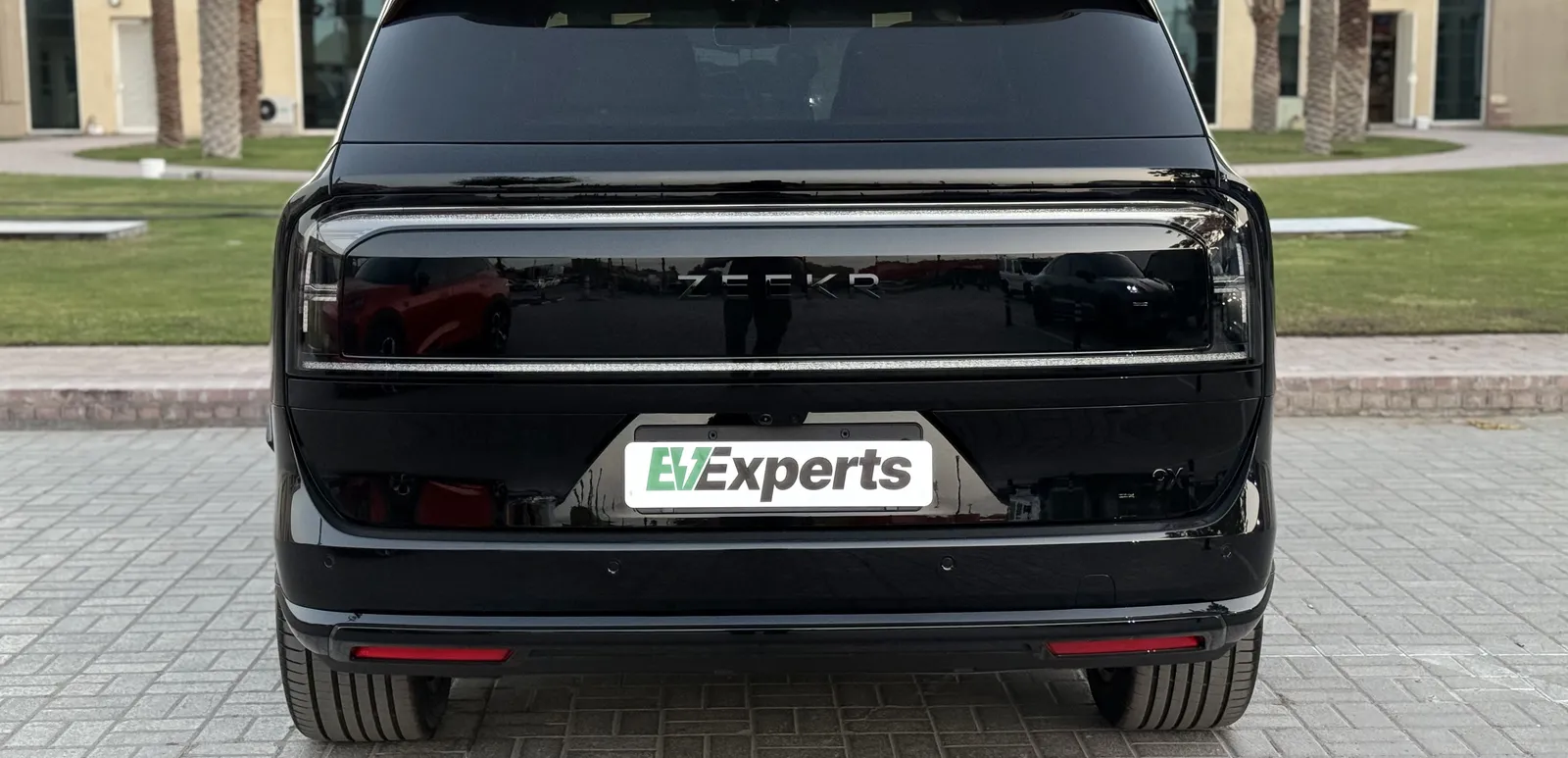
In short. A modern liquid-cooled battery copes with a Dubai summer perfectly well — what you should check is the type of cooling and the warranty terms, not the badge. Range does drop in summer because of the air conditioning, so work from your own daily mileage rather than the brochure figure. An EREV removes the question altogether: you drive on electricity every day, and on the highway or in the heat the petrol generator takes over.
The standard objection to an electric car in the UAE goes like this: “the battery will die in summer.” It is not an invented fear — heat really is the most aggressive factor for a battery, more so than mileage. But between “heat is bad for batteries” and “an electric car makes no sense in Dubai” sits a great deal of engineering. Here is what actually happens in July, and what to check in a car so that it does not affect you.
What heat does to a battery
Three separate mechanisms.
Temperature ageing. A battery ages faster when it spends long periods hot. The key word is “long”: the damage does not come from driving, it comes from hours parked and baking — and, separately, from fast charging an already hot battery.
Power limiting. When a battery overheats, the electronics restrict output and charging speed to protect it. That is where the “my car charges slower in summer” stories come from.
Energy spent on cooling. The air conditioning and the battery’s own cooling both draw power. Summer range is always below the brochure figure — that is normal, not a fault.
The good news: engineers work on all three, and it is their work you should be checking when you buy.
Five things to check when buying a car for the UAE
1. Liquid battery cooling. This is the main one. In modern premium models the battery is cooled by liquid rather than air, and its temperature is managed continuously — driving, charging and parked. Ask directly: liquid cooling or air?
2. A heat pump and pre-conditioning. The ability to cool the cabin and the battery in advance, from the app, while the car is still in the car park. In Dubai this gets used every day, not once a season.
3. Charging speed — as a heat factor. The faster the car charges, the less time it spends standing in the sun. The 900V architecture in the Zeekr flagships takes the battery from 20% to 80% in around nine minutes — which, besides being convenient, means less time in a scorching car park.
4. Battery warranty terms. Its own duration, its own mileage limit and a requirement on remaining capacity. Before you buy is the only right moment to read it.
5. Gulf-specification climate settings. Cars built for the domestic Chinese market and cars built for the Gulf are calibrated differently — in a GCC version the battery cooling and the air conditioning are specified for the summer we actually have here. Ask the manager which version you are looking at: this is where the difference is practical rather than paperwork.
Real-world summer range
Official figures are measured on a gentle cycle that knows nothing about a Dubai July. With the air conditioning on maximum, fifteen-minute trips and a cabin that starts out baking, real range is always noticeably below the claim.
Which leads to a simple conclusion that saves a lot of worry: do not compare cars by the number in the brochure. Work out your own pattern. How many kilometres does an ordinary day come to — school, office, Marina, home? If your daily distance is a fraction of the electric range, you will not notice the summer at all. If you are running to the edge of the official range every day, summer will be uncomfortable.
Charging at home: villas and apartments are different stories
A villa. You install your own charger, the question is settled once, and from then on you charge overnight on the low tariff and forget that public stations exist.
An apartment. Here it depends entirely on the building. Many newer Dubai developments already have chargers in the car park — in which case the question answers itself. Some do not, and then it becomes a matter of approval from the management company, finding a suitable point, and working out who pays for the electricity.
So the first thing to do before buying is to ask your own building whether there are chargers in the car park, how many, and whether you may install your own. It is one call to the management company, and it settles more than any spec sheet.
Why the UAE buys EREVs
An EREV is an electric car with a petrol generator on board. Electric motors always drive the wheels; the engine runs as a generator when the battery is low. For Dubai that layout lands exactly on the use case.
Every day you drive on electricity. Electric range on the models people actually buy here runs from roughly 235 to 410 km. For city use that is plenty: you charge at home or at the office, and no petrol is used.
On the highway you do not think about charging. Abu Dhabi, Oman, a Friday run out of town — you plan the route like any other car. Total range for these cars averages around 1,200 km, and on some models reaches 1,600 km on the CLTC cycle.
In summer you have a safety net. The air conditioning used more than you expected, the station is occupied, there is a jam on Sheikh Zayed — nothing happens, the car keeps going.
You do not need your own charger to own the car. It makes ownership cheaper, but it is not a condition of it.
And some models never need a public charger at all. Li Auto, for example, is a series hybrid: the wheels are always driven by the electric motor, while the petrol engine works as a generator and charges the battery as you go. A car like that can run on petrol alone, like any conventional car, refuelling at any station.
Practical habits for an owner in the UAE
- Do not leave the car in the sun at close to zero charge for days on end — that is the worst case for the battery.
- Use pre-conditioning from the app: the cabin is cooled from the grid rather than from the battery.
- Tinted windows and shaded parking do more than any setting.
- Do not chase 100% charge every day — everyday trips do not need it.
- In summer, plan fast charging for before the heat or after sunset rather than two in the afternoon.
Frequently Asked Questions
Will an EV battery survive Dubai heat?
A modern battery with liquid cooling and active thermal management is designed for a hot climate. What you check is the type of cooling and the warranty terms, rather than the brand as a whole.
How much range do you lose in summer?
Noticeably — because of the air conditioning and the battery cooling. So work from your own daily mileage with headroom, not from the official figure.
What is better for the UAE: a full EV or an EREV?
If you have a villa with your own charger and rarely leave town, a pure EV works well. If charging at your building is uncertain, or you regularly drive to other emirates, an EREV is more practical.
Does fast charging in summer harm the battery?
Frequent fast charging on a hot battery accelerates ageing. Good thermal management helps, as does a high-voltage architecture that shortens the charging time itself.
What to do next
Tell us how you drive: villa or apartment, how many kilometres a day, whether you travel to other emirates. We will match a car to that pattern and show you on a test drive how the climate control and the range actually behave in real Dubai weather — not in a brochure. The cars in question: Zeekr 9X, Zeekr 8X, ROX Adamas.